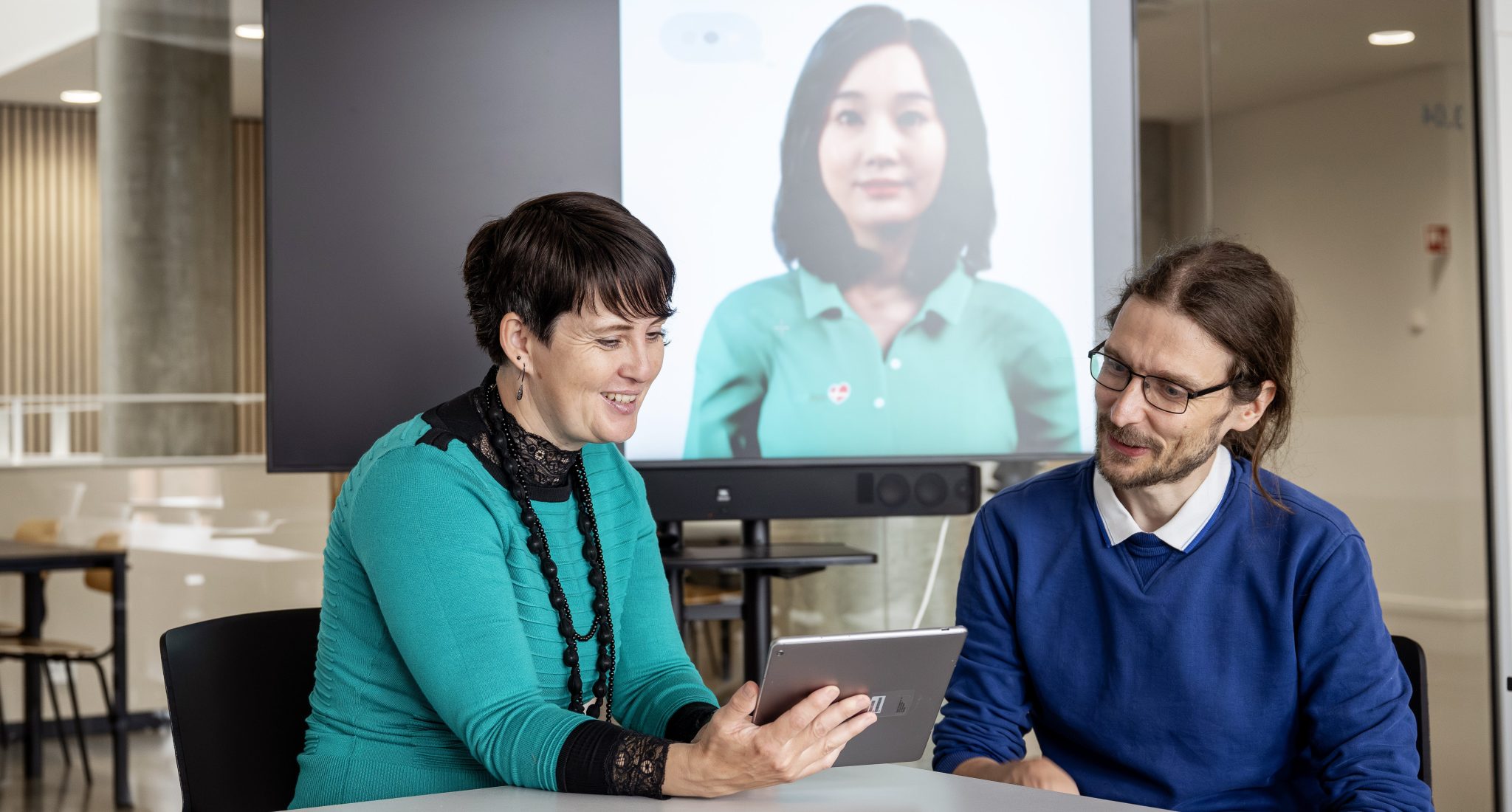
Perhaps you have already experienced it: visiting a company where the receptionist has been replaced by a screen instead of a real person. The screen features a digital human who welcomes you with a smile.
The human-like avatar asks you to enter your name, helps print the visitor badge you need to wear, and calls the person you have come to see.
Depending on our age and gender, we respond very differently to encounters with receptionists like this, as well as the many other chatbots and digital humans we increasingly interact with in everyday life. Anne Dorthe Larsen, Associate Professor and lecturer in e-commerce at the IBA, knows this from her research. Together with Associate Professor Edward Abel from Data and Information Science at SDU, she has examined people’s perceptions and reactions by presenting selected test subjects with different avatars.
Their empirical studies show that if you belong to Generation Y, born between 1981 and 1996, you tend to perceive encounters with digital humans more positively than Generation Z, born between 1997 and 2012. Men also tend to respond more positively to avatars than women, regardless of whether they belong to Generation Y or Generation Z.

“As human beings, we try to keep avatars at arm’s length, but we are programmed in such a way that we quickly forget this when talking to them. We simply cannot help interacting with them when we encounter them,” says Anne Dorthe.
Overall, the research showed that the female test subjects were more reserved and had higher expectations of the digital avatars and their interactions with them. One participant explains in the study:
“It was actually quite demanding to communicate with her. Somehow, I felt responsible for asking the right question in order to get the right answer. And I am fairly convinced that she would not have been able to pick up on it if I had been ironic.”
The researchers chose to focus on Generation Y and Generation Z. A group of men and a group of women were each placed in front of a screen that could register both their eye movements and facial expressions. They were then presented with different avatars and subsequently interviewed in depth about their experiences. The general studies revealed some interesting differences.
“We saw a tendency for the younger generation, Generation Z, who have more experience with avatars, to have higher expectations of digital interfaces. One test subject from the younger generation actually laughed when an avatar failed to recognise an ordinary word during their dialogue,” says Anne Dorthe, continuing:
“Male participants were generally more positive when we subsequently asked them how they perceived the avatar’s personality. Men were more likely to feel that they had had a social interaction with it and perceived its ‘body language’ as natural.”
In the experiment, Anne Dorthe and Edward asked the test subjects to choose between four different avatars: a doctor, a receptionist, a nurse and an HR assistant. They quickly discovered that factors such as gender and age greatly influence our expectations and reactions.
For example, when the test subjects were asked to choose which avatar they would prefer as the doctor delivering a diagnosis, a large majority chose a male avatar, preferably one who appeared experienced and mature.
“Using the equipment, we could see that the male avatars generally received the most attention in this part of the task. One participant explicitly explained that she chose an older man because he seemed attentive, compassionate and empathetic, and looked as though he was good at his job,” Anne Dorthe recounts.
The preference for a male avatar changed when the test subjects were asked to identify the digital human they thought should be the company’s receptionist. Here, their eyes searched for female avatars.
One female participant explained her choice of a younger female avatar as follows: “She looks like someone who works behind a counter. I think most of the receptionists I have met have looked like her. She does her job and is good at it. She gets things done.”

The lecturers’ research shows that companies have very good reason to think carefully before deciding on the gender, appearance and age of their new digital assistant. Users’ own demographic factors strongly influence how they perceive avatars.
“It is important that companies developing and implementing avatars are aware of different consumer perceptions and consider the design carefully for each individual target group. Perhaps they should give people the option of choosing which type of person they would like help from,” Anne Dorthe suggests.
One of the companies they collaborated with on the project is NTT DATA Business Solutions, headquartered in Horsens. Maria Pelch, Product Director in AI & Robotics, welcomes the two lecturers’ research, as it gives her useful insight into how demographic factors affect each individual’s perception of an avatar.
“While our day-to-day work is driven by urgent customer needs, our research collaboration with Anne Dorthe and Edward gives us access to a more methodical approach. Their studies have helped us understand the underlying mechanisms, potential and challenges involved in working with digital humans,” says Maria Pelch.
She continues:
“With this new knowledge, we can adapt our product development plan to better ensure that we build the best solution for the setting in which it will be used.”

The researchers encourage companies to consider whether there may be reasons to follow the target group’s preferences for an avatar, for example for sales purposes or in connection with a medical evaluation. Conversely, there may also be reasons to challenge users’ biases in order to influence them and break down barriers.
Anne Dorthe uses her new knowledge of artificial intelligence in her daily teaching, sharing it with students on the Professional Bachelor’s Degree Programme in E-Commerce and Digital Marketing and the Professional Bachelor’s Degree Programme in E-Commerce at the IBA.
Read the full project on EA Viden >>
Also read: Research: Encounters with Digital Humans Are More Than Technology